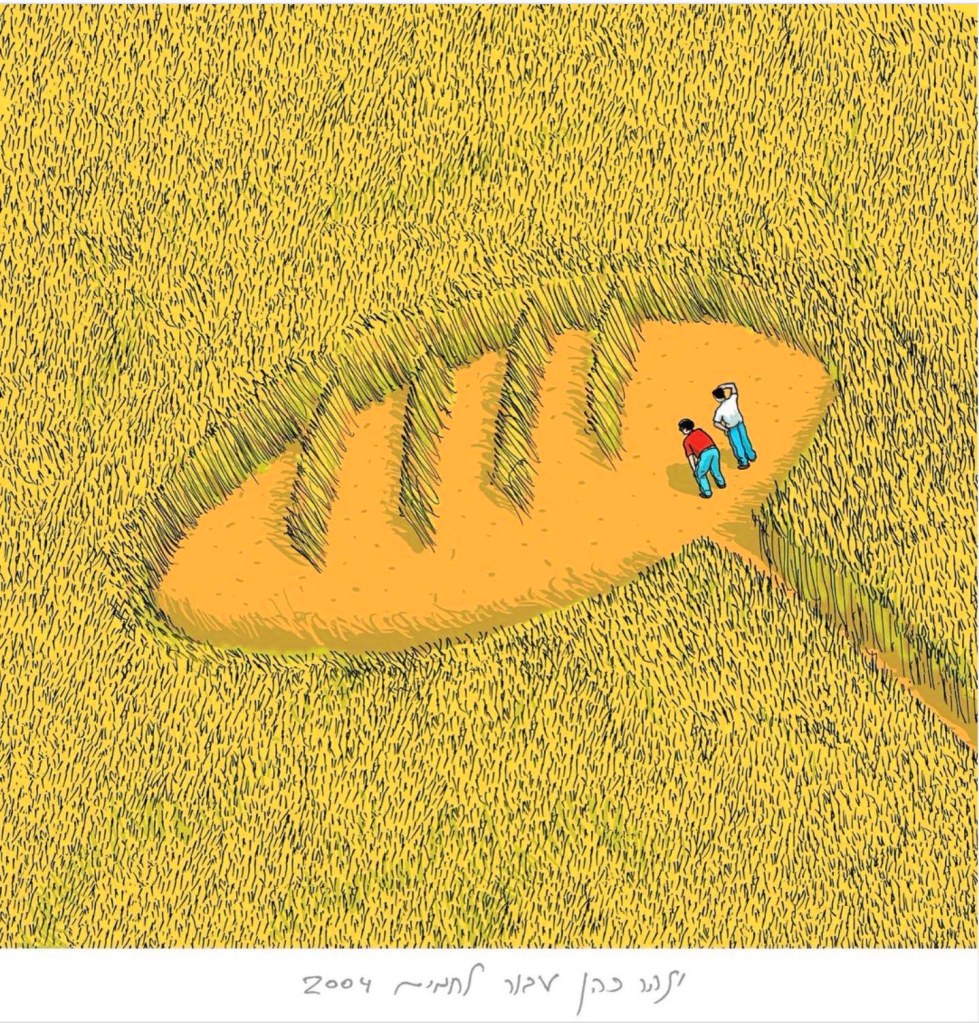
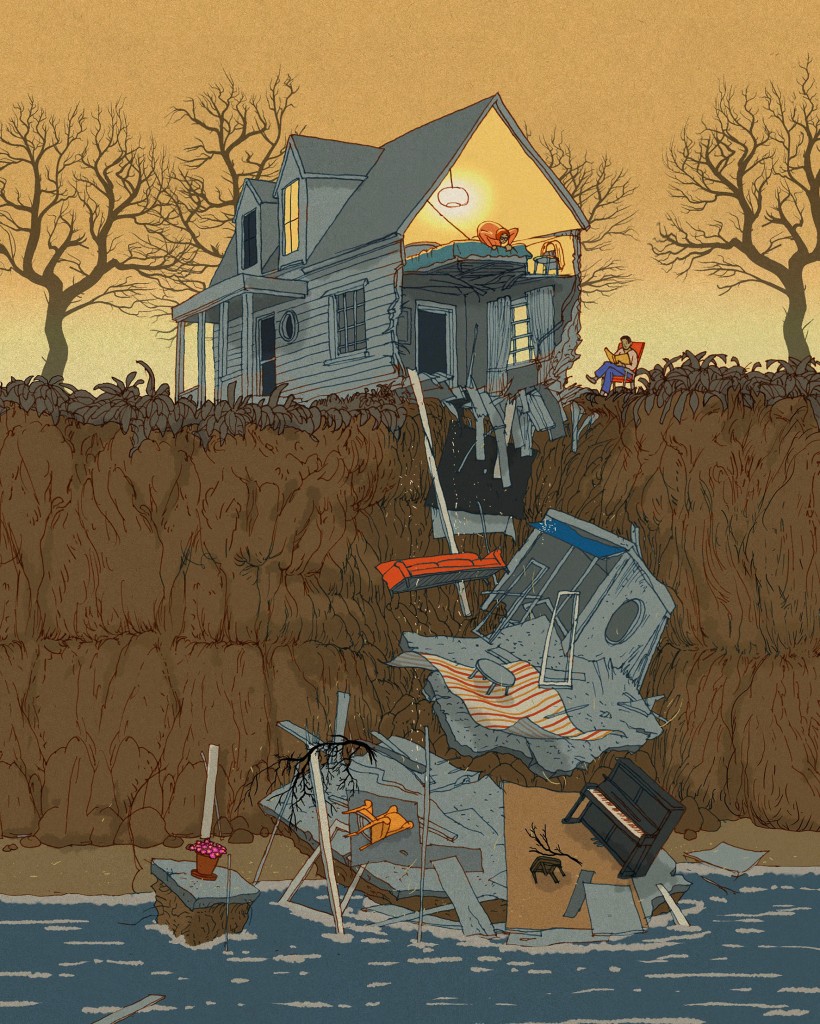
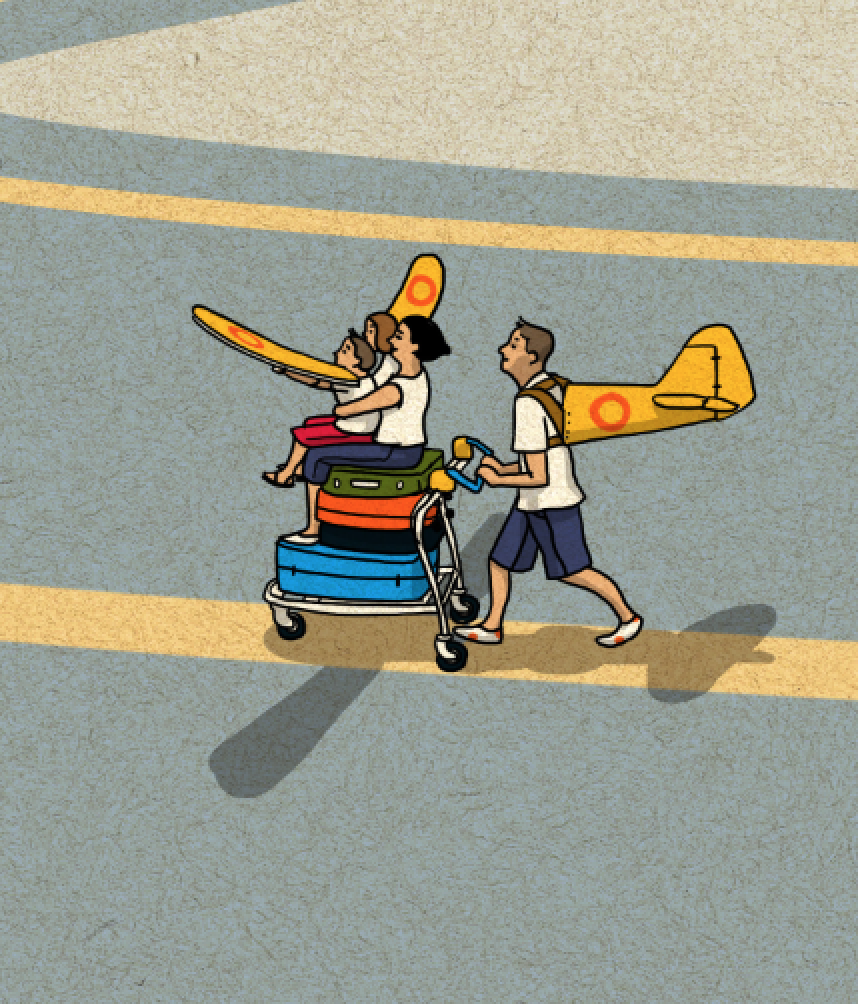
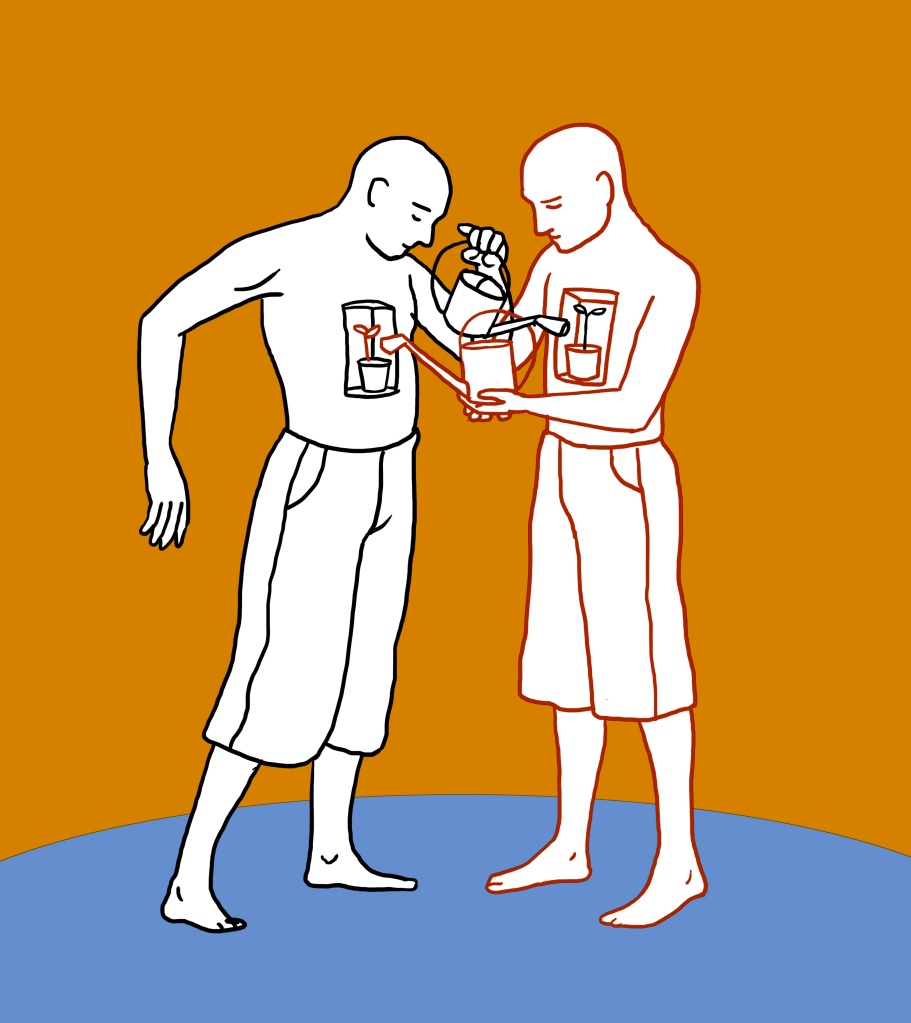
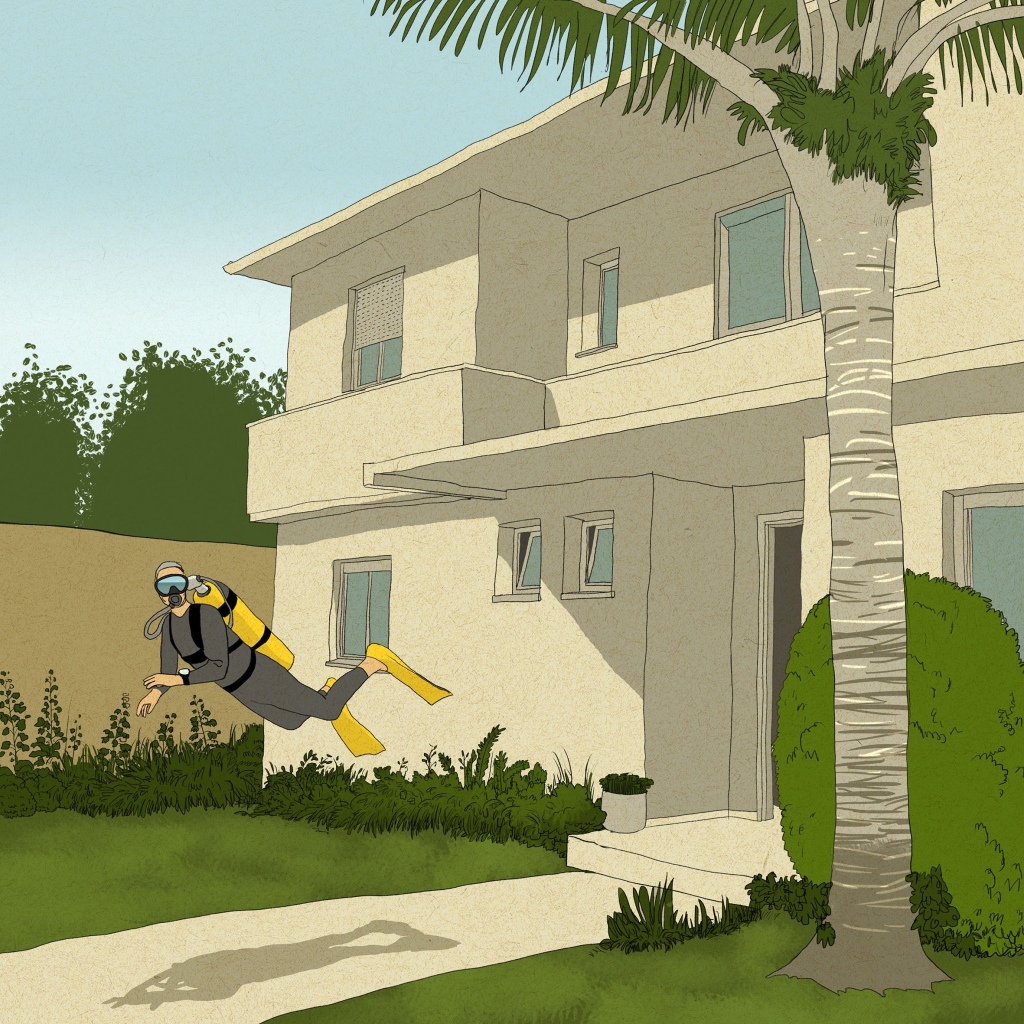
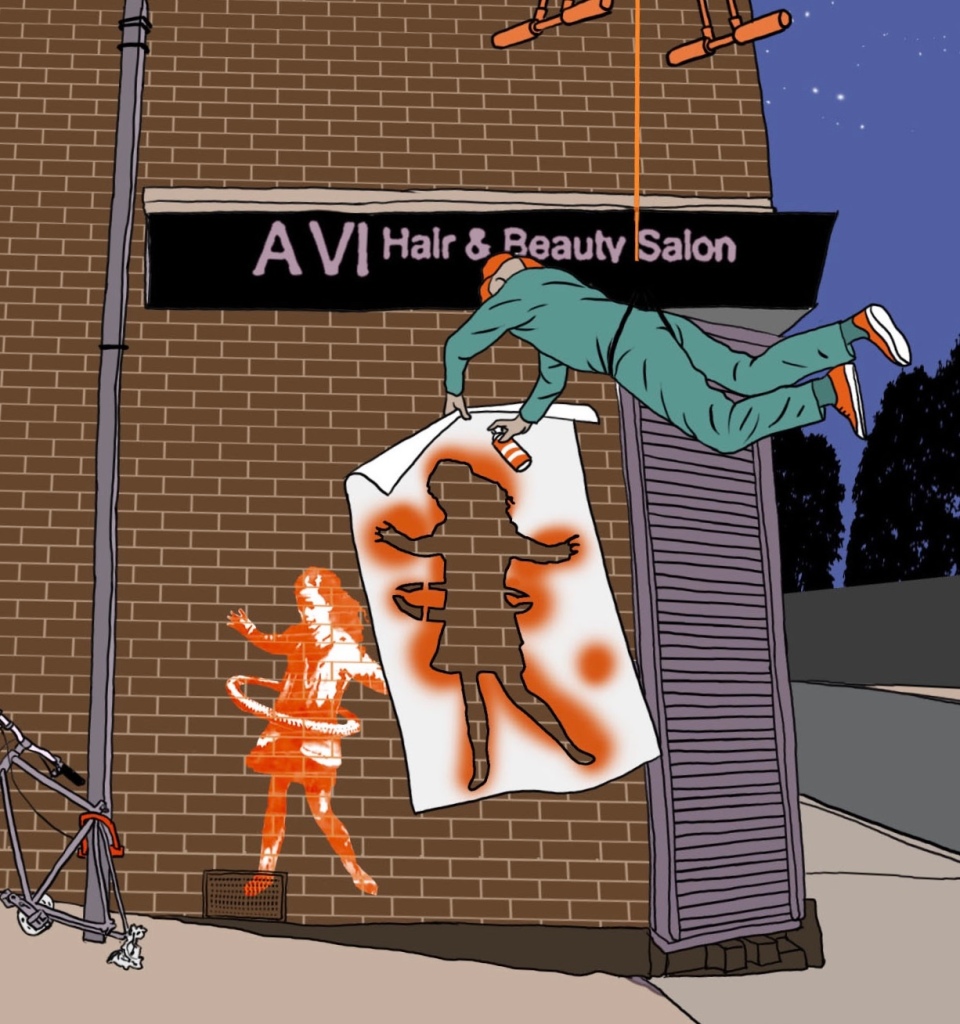
These illustrations appeared last week in the Paris MATCH.Paris Match: Saving in times of crisis
May 3, 2011
These illustrations appeared last week in the Paris MATCH.Tangled in the Social Network
May 1, 2011My birthday, today!
April 20, 2011Tel Aviv-The city that never sleeps
November 24, 2010This years’ Lonely Planet’s top 10 cities for 2011 could not resist the charms of Tel Aviv, The city was nominated the third top city to be visited in the world.
The municipality, prior to the announcement, commissioned me to work on this year’s calendar around the theme of the city that never sleeps. So, here it is for you to enjoy.
Just before I have launched this post, my dear friend Kinneret, sent me link to her post about this calendar.
✹ A limited edition of high quality canvas prints of the series, is available to be purchased. 37cmX60cm.
An interview in Ha’aretz- Shira al haderech
July 1, 2010Here is a link to an interview I had with Nirit Anderman, from Ha’aretz newspaper in Israel about the Tel- Aviv Poetry project.
It is in Hebrew, so, please accept my apologies, my English reading viewers.
The Washington Post- An offer I could not refuse
July 1, 2010Sometimes it just happens. I get this mail from the WP art director, saying that they’ve seen m work and would like to work with me.
I was in no position to refuse.
So here are the fruits of this most pleasurable task, the cover for their Summer Read supplement and an inside illustration for the thriller books page.
Tel Aviv Poetry on the route – Shira al haderech 2010
July 1, 2010
In my previous post I have mentioned a ‘secret’ project. Well, by now my secret has been reveled.
The bi-yearly Shira al haderech-Poetry on the route project, realised by the Tel Aviv municipality, was confided in my hands this time round.
The project presents poets and poems by established poets as well as winners of the recent Shira al Haderech poetry competition.
The way in which the project is present in the public domain is through printed media; large banners in various formats (some 3mX1.7m, some 4.5mX1.7m) As well as posters on bus stops, waste disposal lorries and smaller banners.
More than 50 poets and poems, printed on more than 150 banners, stretched between the trees in the Rothschild, Hen and Ben-zion boulevards.
The project invited me to confront a skill in which I consider myself not to be at my very best- portraits.
Therefore, I started looking for an approach that would reduce the weight of the facial portrait of the poet in question, and will present her/him, in a wider context.
That context, for me, were the boulevards in which the posters, banners were hanged.
So, I have devised a Layout for the project which involved: a branch of a ficus tree, suggesting it is stretched out of the tree to which the banner is attached to. The poet’s figure, positioned on that branch, while reading or writing, and the citation or the entire poem next to it, respectively.
And thank you Mr. Kandel for persuading me to go and see it. It was well worth it.
So here are some of the banners with the names of the boulevards in which they are exposed:
An update
May 18, 2010Since I came back from our trip in Holland and the UK, I was busy on a massive project, which for the time being needs to remain a secret until it will present itself in the public domain.
So, now that this project is behind me, I thought it was time to share some of my latest drawings.
First, here is something I suspect I have never done before:
A portrait of Shmuel Dankner for the cover of G.
magazine
This gentleman, is alleged to be implicated in a real estate scam at the highest echelon of the israeli business arena.
As it was an emergency, I was pushed by the amiable and talented art director of the magazine, Sharon Rodnic to confront the task, as always, with very little time … I suppose that if I was allowed more time I would probably wouldn’t have taken it on as I consider myself as a rather modest portraitist.
Why are there no gay CEOs?
This was the question at the center of the article I was invited to illustrate for Calcalist lest week, so here is my interpretation of that theme.
And now, here are some Harfords:
Why recessions aren’t all about job losses
“Imagine a recession on Planet Vulcan. Thanks to weak demand, an able and hard-working Vulcan subordinate is simply not doing enough business to justify his salary.”
You can read the rest of Tim’s article here
Should I bet against my party winning?
Dear Economist,
As canvassing for the general election gathers speed, I’ve been thinking about the gambling possibilities. Without going into specifics, I’m considering placing bets on the rival team’s victory – as insurance in the event of having to live in a world not entirely to my liking.
Would this be psychologically effective, or am I wasting my money? What price should I place on my political ideals?
Justin, south-east London
You can read Tim’s reply here
Fried chicken versus fresh air
Family Harford is now safely installed in one of the grimmest parts of Hackney. Just outside the back door is a “massage parlour”, a kebab shop, a jerk chicken joint and a betting shop, not to mention flowers for the young man who was recently shot dead outside a local nightclub. At the front is a row of abandoned cars, courtesy of the garage just across the road and the other one just round the corner. Delis are there none.
You can read the rest of Tim’s article here
Hard cash underpins the spirit of independence
Energy. Ambition. Confidence. Patience. Fearlessness. All these traits are associated with that mysterious quality of “entrepreneurialism”. Self-made men, such as Richard Branson and Alan Sugar, seem to exude different qualities from ordinary wage slaves.
You can read the rest of Tim’s article here
Wanted: less exploitative ways to do more with less
On a visit to India last year, I bought some shampoo from a roadside kiosk in Kolkata. This was largely unremarkable, although like any shopping trip further afield than Dublin, it brought a frisson of excitement.
You can read the rest of Tim’s article here
A marginal victory for the well-meaning environmentalist
At the risk of turning this column into “The Undercover Environmentalist”, I need to return to that vexed question of carbon dioxide emissions. In my first column of the year, I vowed to reduce my carbon footprint from air travel – easy enough, given that it was 50 tonnes of CO2 last year. A kind reader wrote to reassure me that I needn’t lose any sleep, because the planes were making the journey anyway. Glib, I know: I’ve often said it myself to wind up environmentalists.
You can read the rest of Tim’s article here
At last the con has been taken out of econometrics
In 1983, Edward Leamer published an article with contents that would become almost as celebrated as its title. “Let’s Take the Con Out of Econometrics” began with an analogy that remains useful. Imagine an agricultural researcher who tests the effectiveness of a new fertiliser by dividing land into strips and spreading the new fertiliser only on a randomly chosen selection of those strips. Because of the randomisation, any effect will presumably be thanks to the fertiliser.
You can read the rest of Tim’s article here
Should I become a vegetarian?
Dear Economist,
A growing trend among my fellow students is converting to vegetarianism for environmental reasons, citing statistics that meat production, in particular beef, is a tremendous cause of greenhouse gas emissions. I was wondering if you could provide some insight into the actual environmental cost of a steak. How does it compare to driving, or flying? Would a simple tax on beef production be much more efficient than vegetarianism?
Max
You can read Tim’s reply here
The straw that broke the camel’s back
May 2, 2010I often raise doubts regarding my ability to convey a particular message through my illustration.
On this occasion, be it for technical printing difficulties or faults in my crafting of the image itself, I seem to have failed in my attempt to communicate an idea.
Lapid wrote last week in his column, a poignant piece centered on the socioeconomic imbalance between religious and secular in Israel. Yair raised the alarm, while using a metaphors of a car, driven by the seculars, which would no longer be able to carry its ever-increasing in number load of religious passengers.
As I was making an effort to complement this metaphor with another, I have chosen to try and depict the concept of: The straw that broke the camel’s back.
I worked on a simulation of an X-ray of a camel, who’s back is falling a part while a single straw is falling on top of a heap of straw packed on its back.
… and here I seem to have failed.
Questions were raised by some of my most dedicated and avid followers, regarding the nature of that beast, and how, if at all is it related to the article.
So, with my sincere apologies, here is the illustration as I sent it to the paper, with the hope it might clarify the matter.
10 years a go….
May 2, 2010…I was invited by the city of Breda in Holland, to create a 14 meter long by 1.5 meters high tiled wall for their new Sonsbeeck municipal swimming pool.
This was, and still remain one of the most exciting projects I was involved in.
Through this project I had the chance to meet some incredible people of rare qualities.
In particular, the artists at Tichelaar, Holland’s oldest ceramic company.
They’ve departed from scaled down drawing which I provided them with, and through a very laborious process, they turned it into a magnificently colourful tiled wall.
Since our daughter, Alma, was born, we promised ourselves to go there with her and see it again.
Ten years after the opening we found the wall in its same immaculate condition as it was on its first day. We left Breda with a big smile on our faces.
Israel independence day
April 19, 2010Well, some independence… Yair Lapid and Raanan Shaked shared a written exchange between them around their sentiments with this years day of independence in a special supplement of Yedioth.
I must say, throughout the last two years I can sum up my own feeling about the state of Israel as grim and quit desperate. Raanan started off with a very harsh, kicking and bitter description of the israeli reality, without mincing his word nor with any pity on any the main protagonists in the current sorry state of affair of Israel .
Yair replied with wit and balance, raising the argument of the inevitability of the future existance of the state of Israel, maintained by the impossible coalition of sane people who still form the majority. He then invited Raanan to pick the glove and join him in his endeavor of helping the sane, no matter their provenance.
I have picked this metaphor and projected it on my illustration.
I have accompanied the main illustration with a variety of gloves, each, attached as a letterhead to each text.
towards
Möbius band and the glass ceiling
April 18, 2010This one was for Calcalist. The article brought the testimonies of five women who shared separately, the experience of encountering the unpleasant banging in the head of the transparent, yet, very real glassceiling.
Just before publishing, the illustration was chosen to figure on the cover, so, as an emergency measure, I had to come up with an additional full-page illustration. I shall not be revealing the time it took for execution…
Excellence vs childhood
March 29, 2010In a letter sent to Harford, parent raised a series of questions in reference to their child’s omnipotence. They were curious to know which way should encourage their son to go.
At the same time, they expressed their concern about the lost of his childhood while turning him into an all-round super kid.
Terrorist Rehabilitation
March 29, 2010Harford’s article this week evolved around the rehabilitation of terrorists. one of the possible incentive raised in the article was the positioning of the subject to the joys and responsibilities of parenthood….
Lapid on temple mount, הַר הַבַּיִת, الحرم القدسي الشريف.
March 29, 2010Last week, following the confrontations between Israelis and Palestinians on temple mount, Yair wrote about his experience while visiting the underground labyrinths excavated at the heart of the temple mount in Jerusalem.
He was accompanied by the rabbi of the Kotel and shared with the readers his encounter with the historical layers upon which both the Mosques and the Kotel reside.